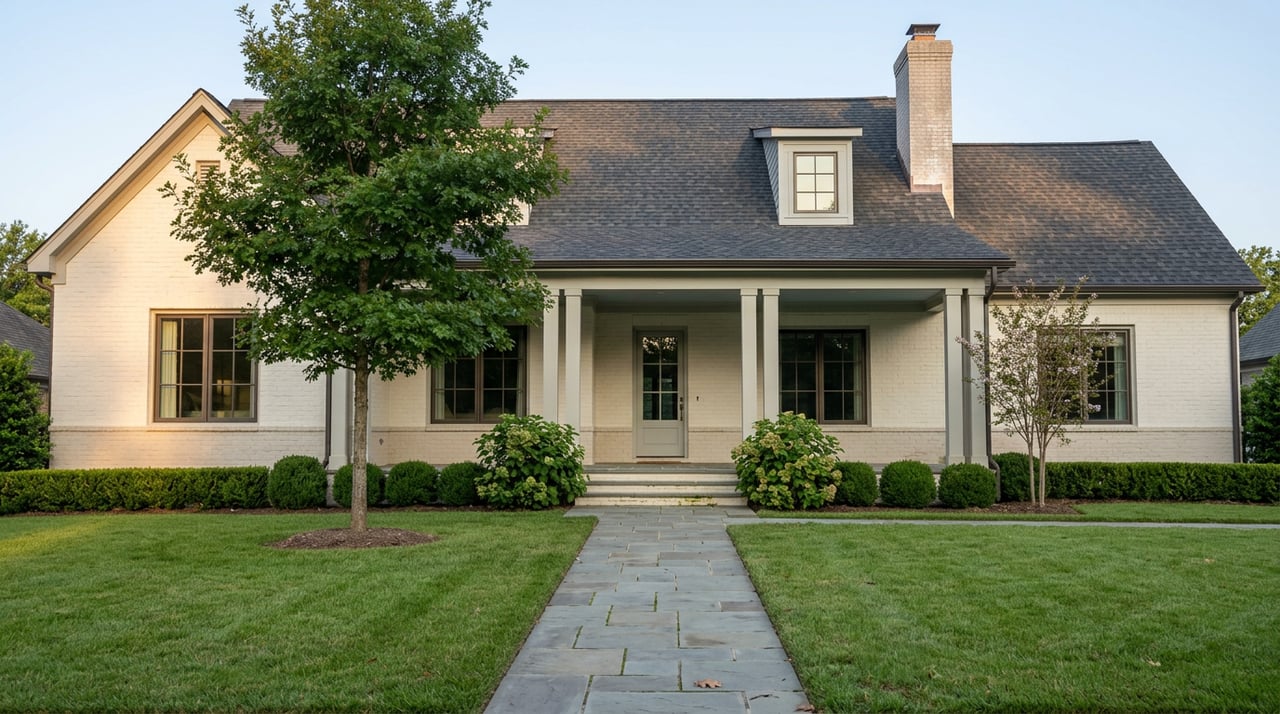
A buyer closes on a bungalow near Hincheyville, picks out a soft sage for the porch trim, and calls a painter to get it done before the leaves turn. The painter asks one question before anything else: what year was the house built, and is it inside the historic overlay? If the answer to the second question is yes, the paint color is no longer a decorating decision. It's an application.
That's the part the listing sheet never mentions. The price per square foot tells you what the house costs to buy. It says nothing about what it costs to touch.
The Process Starts After You Own the House
Franklin's downtown core sits inside a Historic Preservation Overlay, and any exterior work on a property within it goes through the city's Historic Zoning Commission before a contractor can start. That covers more than paint. Additions, porches, fences, driveways, mechanical equipment, rooftop features, even partial demolition all require a Certificate of Appropriateness, and the city's own guidance spells out which projects need full commission review versus a faster administrative sign-off for minor, non-visible changes.
Contractors who take on these projects regularly describe a review window that commonly runs 60 to 90 days for something as ordinary as an exterior repaint, because the commission isn't approving a color, it's approving a justification. The strongest applications tie the proposed color and material back to the home's architectural period and to what similar buildings on the same street already show. "We like this color" isn't a justification the commission can act on.
If you're a buyer planning to touch the exterior in year one, that timeline needs to sit next to your renovation budget, not after it. If you're a seller who has already been through the process, your paperwork is an asset. A documented, approved Certificate of Appropriateness for a past renovation tells the next owner the work already cleared review and won't need to be redone or re-justified.
Not Every Historic Label Means the Same Thing
Buyers touring Franklin often assume any home described as "historic" carries the same restrictions. It doesn't. A property can sit on the National Register of Historic Places, which formally recognizes its architectural or historical significance, without that listing placing any restriction on how the owner uses, alters, or sells it. What actually triggers commission review is a separate, narrower designation: a locally adopted historic district, created by city ordinance and enforced through the Historic Zoning Commission.
Franklin has five National Register districts totaling more than 1,060 buildings, and a slightly different count of seven locally designated historic districts, ranging from the five-parcel Everbright Avenue Historic District up to the Franklin Road Historic District, which stretches nearly two miles north of downtown. The distinction matters because it's entirely possible to buy a home with genuine 19th-century bones that isn't subject to design review, right next to one that is.
| District | Character | What it typically means for owners |
|---|---|---|
| Adams Street | Folk Victorian, Queen Anne, Craftsman bungalows, built roughly 1890 to 1940 | Local district; exterior changes require COA review |
| Lewisburg Avenue | Larger estates, some with documented Civil War-era history | Local district; premium lots, same review requirement |
| Hincheyville | Mixed 19th and early 20th century residential | Local district; smaller lots closer to the square |
| Franklin Road | Extends nearly two miles north of downtown | Local district; longest corridor, most parcels |
| Everbright Avenue | Five parcels | Smallest locally designated district |
Before you write an offer, the question isn't just "is this house old." It's whether the specific parcel sits inside one of these locally adopted boundaries or simply inside a National Register district that carries no enforceable design requirement. The city's Historic District Design Guidelines document lists the boundaries precinct by precinct, and it's worth checking before you fall for a porch.
What the Median Hides
A tally of closed sales in the downtown core through the first half of 2026 put the median sale price at $675,000. On its own, that number is nearly useless for a historic-district buyer, because price per square foot across those same sales ranged from $185 to $886. A renovated cottage and a purpose-built luxury condo can carry wildly different per-foot economics even a few blocks apart, and homes on Lewisburg Avenue or Adams Street with larger lots and documented architectural pedigree tend to trade well above the median, while condos and townhomes in the same walkable radius trade below it.
That spread isn't random. It's the market pricing in exactly the friction described above: how much of the renovation work has already cleared Historic Zoning Commission review, how large and how encumbered the lot is, and whether the home's documented history adds value or simply adds paperwork. Two houses with the same square footage can carry very different effective costs of ownership depending on how much COA work still needs to happen after closing.
The Rulebook Changed in January
Franklin adopted a citywide rewrite of its Zoning Ordinance, effective January 13, 2026. The new document reorganized how overlay districts and historic resources are reviewed, consolidating the rules that govern historic preservation into their own dedicated chapter. Under the ordinance's transitional rules, any Certificate of Appropriateness, grading permit, or building permit that was already approved and valid before the rewrite remains valid through its original expiration date. But any application submitted after January 1, 2026 falls under the new structure.
For a buyer inheriting a seller's partially completed renovation, this matters. Ask specifically whether existing approvals were granted under the old ordinance or the new one, and confirm the expiration date in writing. An approved COA that's about to lapse is not the same asset as one with a year of runway left.
The Boundary Isn't Always Fixed
Historic overlay boundaries themselves aren't permanent lines on a map. Earlier in 2026, Franklin's Board of Mayor and Aldermen took up a rezoning request tied to 202 acres at 354 Franklin Road that would have adjusted the boundary of the Hillside Hillcrest Overlay near Roper's Knob, a Civil War-era signal station listed on the National Register of Historic Places since April 2000. The Historic Zoning Commission had already weighed in with a preliminary recommendation, conditioning any approval on the requirement that future development not increase visibility from Franklin Road or from the historic site itself. The board advanced the request on a 5-1 first-reading vote and scheduled a public hearing for May 12, according to the Williamson Herald.
The specifics of that one parcel matter less than what the episode demonstrates: land near a historic resource can have its development potential expanded or restricted by a vote, not just by ordinance text sitting untouched for a decade. If you're evaluating acreage anywhere near Franklin's protected sites, ask whether any overlay adjustment is pending, not just what the map shows today.
Before You Write the Offer
A short list worth working through before you commit:
- Confirm whether the parcel sits inside a locally adopted historic district, not just a National Register district. Only the local designation triggers Historic Zoning Commission review.
- Ask the seller for any Certificate of Appropriateness paperwork tied to past exterior work, and check whether it was approved before or after January 13, 2026.
- If the home predates 1978, plan for EPA lead-safe renovation protocols on any project that disturbs painted surfaces.
- Budget calendar time, not just dollars, for exterior projects. A 60 to 90 day review window for something like repainting is common.
- If the property borders a scenic corridor, hillside, or historic site, ask whether any overlay boundary changes are pending before the Board of Mayor and Aldermen.
- Middle Tennessee's clay soils can cause seasonal movement in older foundations. Stair-step cracks, sticking doors, and uneven floors are worth a structural opinion, not just a general inspection note.
A Few Questions Worth Asking Early
Does a National Register listing by itself require design review? No. The National Register recognizes historical significance but doesn't restrict private property use on its own. Review requirements come from a separate local historic district designation adopted by city ordinance.
How long should I expect a Certificate of Appropriateness to take? Routine exterior projects have commonly run 60 to 90 days from application to approval, based on the experience of contractors who work in Franklin's historic districts regularly. More complex additions or demolitions can take longer.
Who do I talk to before I plan any exterior change? Franklin's Preservation Planner, Emily Huffer, is the city's point of contact for questions about whether a specific project needs review, and a preliminary conversation with her office before drafting plans can save real time later.
What changed with the new zoning ordinance? The ordinance effective January 13, 2026 reorganized how overlay districts and historic resources are reviewed citywide. Approvals granted before that date remain valid through their original expiration, but new applications follow the current structure.
The list price on a historic Franklin home is a starting point, not the whole story. The number that actually determines what you can do with the house, and how quickly, lives in the overlay map and the commission's calendar. If you're weighing a property in Hincheyville, along Lewisburg Avenue, or anywhere inside Franklin's protected districts, Richard F. Bryan can walk through what a specific parcel's designation actually means before you write the offer. Let's connect and talk through the property you have in mind.